
The rain is coming down sideways in Naples. Your train station is close enough to see on the map and far enough that walking there means arriving soaked to the skin. Downstairs, the front desk cannot find you a taxi. So you stand under an awning with your suitcase, breathing in wet stone and the espresso drifting out of the bar next door, and you feel that first-morning-abroad flutter of “what have we done?” Nobody puts this part in the slow travel in Italy brochures.
Then a cab slows, you wave, and finally you are on your way.
I know, because that is exactly how my second trip to Italy started. And that soggy morning is the reason this post exists.
Two Trips, Two Kinds of Slow Travel in Italy
I have been to Italy twice in two years. October 2022 was our anniversary trip: Naples, Sorrento, Rome, Florence, Venice, the Bernina Express, Paris. October 2023 was a road trip with Jim and Aaron: one night in Naples, two in Sorrento, a ferry day out to the town of Amalfi, then almost a week working our way across Sicily.
Two trips. Two different Italys. In the end, the second one taught me more.
The first trip hit the icons: the Sistine Chapel at 8 AM, the Duomo in Florence, the vaporetto to Murano. It was wonderful. It was also, of course, the Italy everyone photographs.
The second trip forced us to slow down, and not always by choice. First, that rainstorm in Naples. A reservation mix-up outside Palermo that cost us a night we had planned in Agrigento and gave us an unplanned one in a beach town we had never heard of. A police stop in Palermo that ended the way it usually does when you have done nothing wrong: they check your documents and wave you on.
That is the Italy I want to tell you about. That is what slow travel in Italy actually looks like, and it is the version I plan for my clients now.
My slow travel rule for Italy: in ten days, choose two regions rather than trying to see five. Use fast trains between major cities, use a car or a private driver selectively within regions, stay in neighborhoods rather than beside the biggest monuments, and leave room for something you did not plan.
Naples and the Train Nobody Warns You About
We landed in Naples with one night reserved in the historic district. Finding the actual check-in, however, took longer than it should have, the kind of small chaos that makes a first night abroad feel bigger than it is. The room itself was fine. We only needed it for the one night anyway.
Unfortunately, the next morning it was pouring. The train station was not far, but far enough that walking in that rain was not going to work, and the front desk could not sort us out a taxi. So we ended up walking partway and flagging one down ourselves.
From Naples we took the Circumvesuviana, the local train down to Sorrento. I would not send a client on this train. There were almost no seats, so we stood the entire ride, just over an hour, no air conditioning, packed in and sweating. It is cheap and it gets you there, and that is the nicest thing I can say about it. In other words, it was a lesson. If I did this leg again, therefore, I would pay for a driver, and that is exactly what I tell clients now.
“It is cheap and it gets you there, and that is the nicest thing I can say about it.”
Sorrento and a Morning in Amalfi
Sorrento, on the other hand, was the reset. Two nights in an Airbnb in a good location, close enough to walk most places we wanted to go. One day we took the ferry out to the town of Amalfi itself, wandered the streets, looked at the cathedral steps, took our time. No itinerary, just a coastal town and a few hours to spend in it. We caught the ferry back to Sorrento that evening.
After that, we made our way back to Naples, most likely by ferry the next morning, and flew from there to Palermo to start the Sicily half of the trip.
Sicily Requires Two Trips (Minimum)

Palermo, Cefalù, and a Slow Travel in Italy Accident
We based ourselves outside Palermo, in Sferracavallo, for what we had reserved as three nights. I lost track of that third night, and we left after two, thinking we had stayed our full stay. That mix-up is the reason the rest of the week unfolded the way it did, and it turned out to be one of the best accidents of the trip.
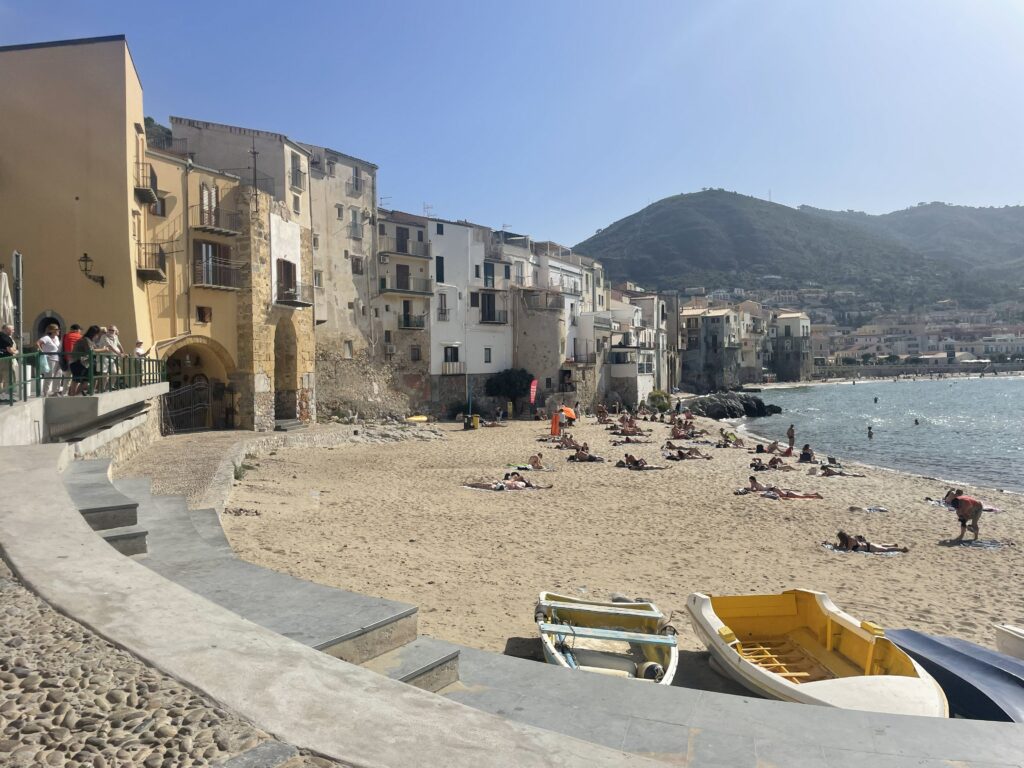
We drove through Palermo itself without really stopping to see it. In contrast, a day trip out to Cefalù was one of our favorite stops of the whole week, a beautiful little beach town we would go back and stay in given the chance.
From there we headed toward Agrigento, planning to stay the night. Because we had already left Palermo a day early, we ended up instead in San Leone, a small beach town near Agrigento we had never planned to see. It turned out to be a blessing, a cute little place with the sea right there. Even so, we still made it to the temples at Valle dei Templi in Agrigento, worth every bit of its reputation.
“That mix-up turned out to be one of the best accidents of the trip.”
Ragusa, Modica, and Syracuse
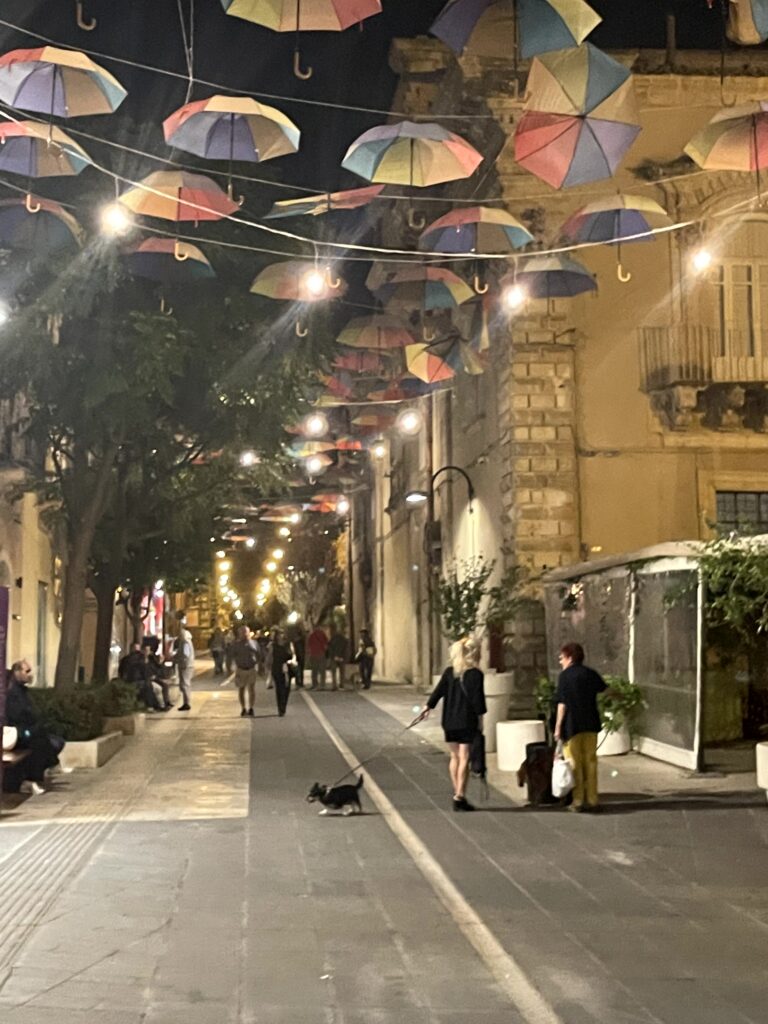
Next came Ragusa, and we stayed there long enough to actually get to know it: chapels tucked into narrow streets, a street strung with umbrellas overhead, and Giardino Ibleo, a park up on the high side of town with views across a huge stretch of Sicily.
From Ragusa we made a day trip to Modica, the town Sicily built its chocolate reputation on, and found a small chocolate museum full of pieces made almost entirely out of it. Then on to Syracuse, where an excellent guide walked us through the archaeological park, and across to Ortigia, the old island heart of the city.
Castelmola and Taormina
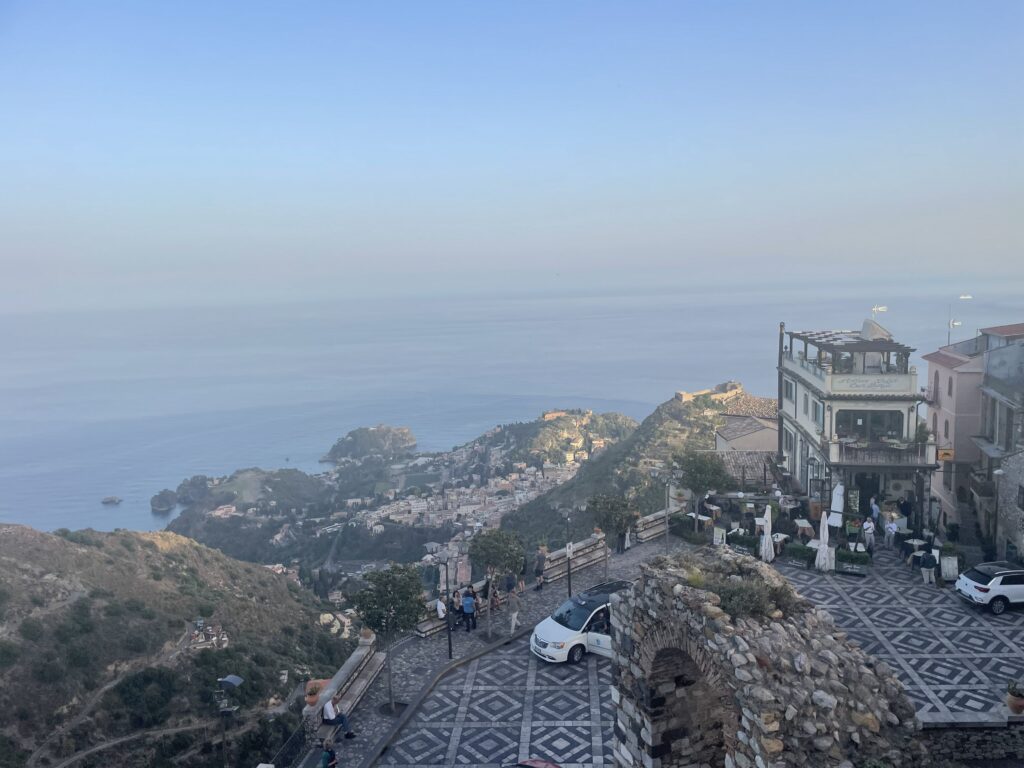
Back in Ragusa that night, and the next day we drove to Castelmola, above Taormina. Jim chose it on purpose, because it looked like exactly the kind of place we would love, and he was right. Sweeping views over Taormina, the coastline, and Mount Etna on a clear day. The switchback road between Castelmola and Taormina is rough enough that we parked the car once and took the local bus back and forth instead.
Likewise, Taormina itself was worth the trip down: good shopping, a smaller old theater we toured (we missed the famous large one, which I still think about). A boat tour out on the water showed us both towns from below, along with a spot familiar to anyone who has seen the TV series that filmed nearby. We stayed two nights in Castelmola and did not want to leave.
Finally, it was Catania just long enough to fly out: Catania to Amsterdam, one night, then home.
Jim drove the entire trip. I did not get behind the wheel once, and after those switchbacks, I was glad of it.
Venice Before Breakfast Belongs to You
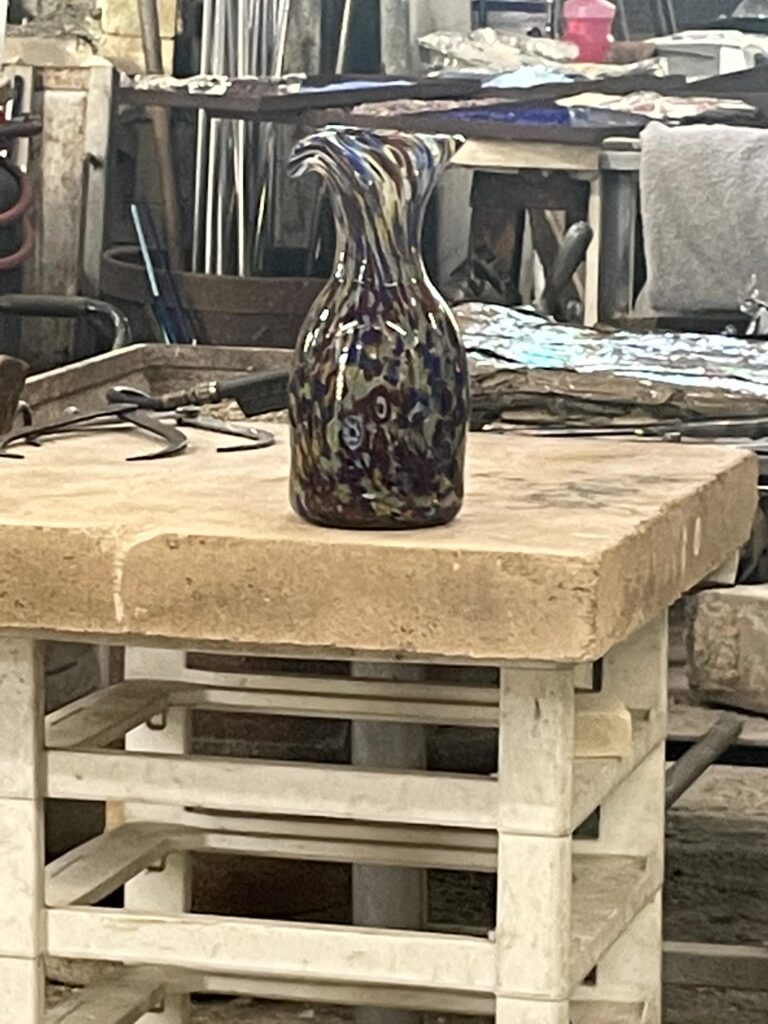
Venice certainly earns its overtouristed reputation, but mostly after mid-morning. Sleep in the city itself, in a neighborhood like Cannaregio rather than on the mainland, and as a result the whole experience changes. Arrive at Piazza San Marco early, before the day-tripper crowds build, and it is a different place: quiet, unhurried, just you and the pigeons and whoever else had the same idea.
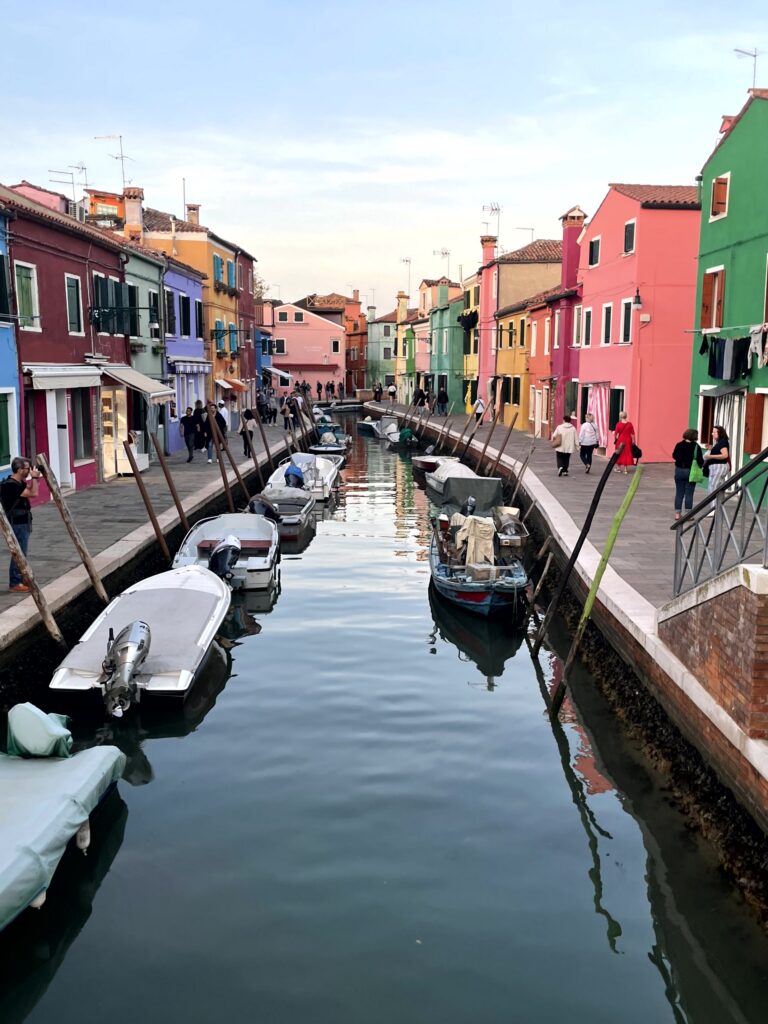
We stayed in Cannaregio on our 2022 anniversary trip, and it is the neighborhood I point clients toward over a hotel right on San Marco. We also spent a night out on Murano first, where we watched a glassmaker turn molten glass into a vase and then a little horse in a matter of minutes, then took the ferry to Burano for an evening among the painted houses and lace shops and stayed for dinner. Those two islands are where Venice slows down.
The strategy I give clients:
- Sleep in Venice itself, not Mestre or the mainland.
- Get an early start: San Marco, the Doge’s Palace, and the Rialto Market before the crowds build.
- Spend the afternoon on Murano and Burano. Murano’s glassblowers shape molten glass into finished pieces in minutes. Burano’s houses are painted in colors bright enough that, as the story goes, fishermen could find their way home even in the fog.
- Save the evening for a residential neighborhood like Cannaregio or Dorsoduro, where dinner happens at the pace of the people who live there.
The Food Lessons That Transcend Region
Carbonara is a test. Guanciale. Pecorino Romano. Egg yolks. Black pepper. No cream, ever. If the menu lists cream in a carbonara, that is a sign to keep walking.
Gelato is not ice cream. Less air, less fat, and served a little warmer. The colors run muted rather than neon: real pistachio is gray-green, not bright. Look for “produzione propria,” house-made, and metal tubs with lids rather than piled-high displays.
Coffee has rules. Cappuccino before 11 AM, by local custom. Espresso standing at the bar. “Un caffè” means espresso. Sit down at a table, however, and the price usually goes up.
Wine by the house is underrated. “Vino della casa” by the carafe is often better than the bottle list, and a fraction of the price. Ask for rosso or bianco and drink what the table next to you is drinking.
The Slow Travel in Italy Framework I Give Every Client
Pick two regions. Maybe three. Italy punishes the “see everything” approach. For example, ten days is enough for something like Rome plus the Amalfi Coast, or Sicily split east and west. Not all of it at once.
Train between cities. Car within regions. The fast trains connect Rome, Florence, Venice, and Milan in a few hours each. Rent a car for regions like Tuscany or Sicily, and return it before the next train leg. On the Amalfi Coast, skip the car: a private driver or the ferry will get you there with your nerves intact.
Stay in neighborhoods, not next to the monuments. That way, you live in the city instead of just visiting it.
Reserve one meal that matters, and let the rest happen. In other words, a special dinner worth planning ahead, and everywhere else, just follow the smell of garlic and the sound of Italian conversation.
Leave room for the unplanned. Our best week in Sicily came out of a reservation mix-up we did not even mean to make. The wrong turn, the missed reservation, the day that goes sideways: more often than not, that is where the actual memory ends up living.
“The wrong turn, the missed reservation, the day that goes sideways: more often than not, that is where the memory ends up living.”
Ready for Your Own Slow Travel in Italy
If you have been saying “someday” about Italy, and the version you picture has more long lunches than long lines, this is the kind of trip I love to plan. Slow travel in Italy is not about doing less. Instead, it is about doing the right things, at a pace that lets you actually be there.
If Italy is calling but figuring out the hotels, trains, drivers, timing, and how much is too much already feels overwhelming, that is exactly where I come in. I will help you pick your two regions, get you off that train, and leave room for the accident that turns into your favorite story.
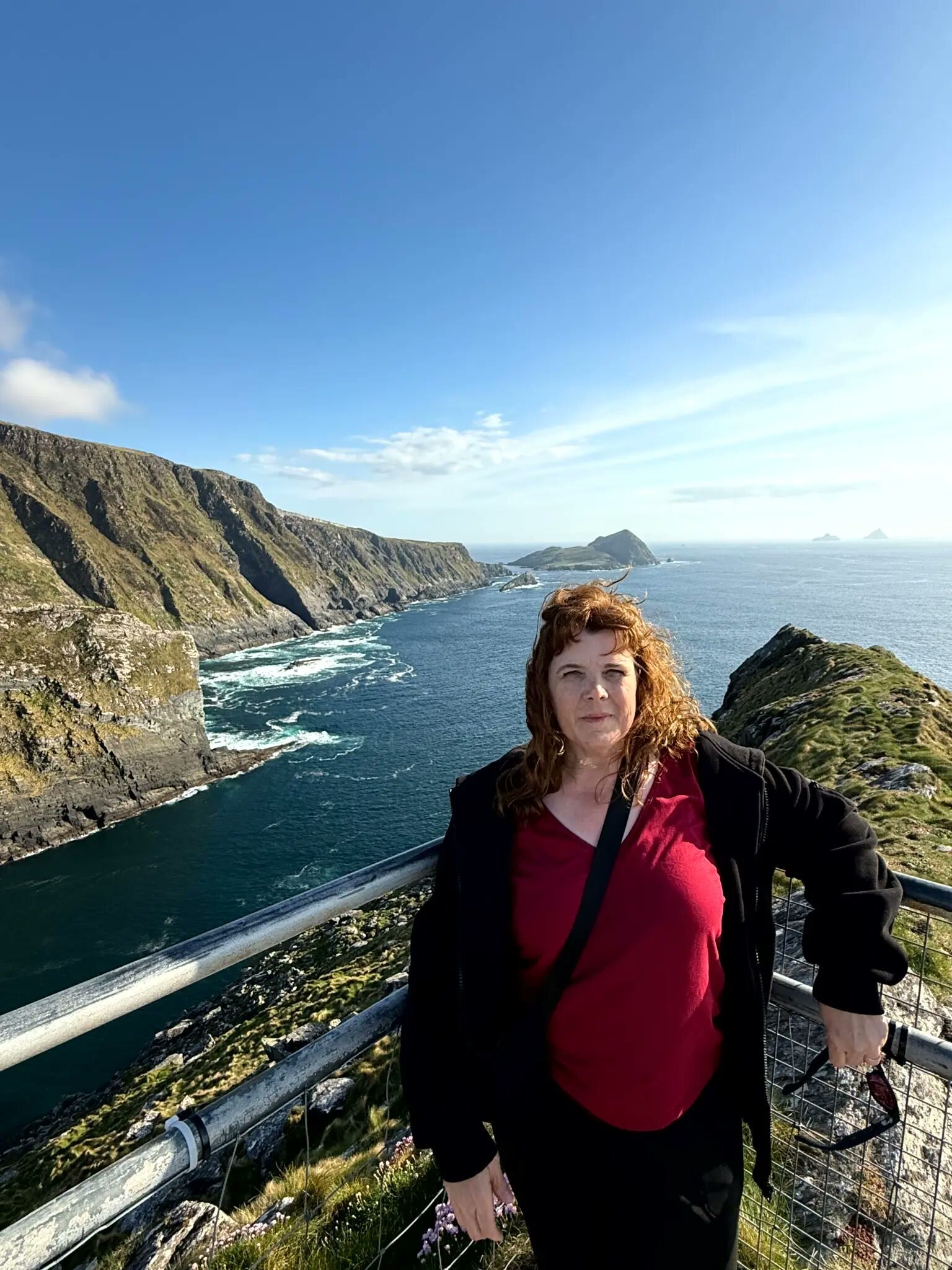
Karla Tugan
Owner & Travel Advisor | Whispering Willow Travel
Every Journey Writes a Story 🌿
FAQ: Slow Travel in Italy Basics
Slow travel in Italy means staying longer in fewer places, using trains between cities and cars within regions, eating where locals eat, and leaving unscheduled time for unplanned moments. It prioritizes depth over breadth: two regions in ten days instead of five.
Generally, ten days minimum for two regions (Rome plus the Amalfi Coast, or Sicily split east and west). Fourteen days for three regions once you account for travel days. Meanwhile, seven days is enough for one region done well.
April through May and September through October. Comfortable temperatures, manageable crowds, and long daylight hours. July and August are hot and crowded, and some family-run restaurants close for their own vacation. Winter is quiet, but some seasonal spots shut down entirely.
FAQ: Planning Slow Travel in Italy
Yes, as long as you prepare. An International Driving Permit, your passport in the car, offline GPS, and awareness of ZTL zones (camera-enforced limited-traffic areas in historic centers). Roads narrow considerably in small towns, and parking is usually at a garage outside the center rather than on the street.
Stay overnight in a residential neighborhood like Cannaregio or Dorsoduro rather than near San Marco. Visit the main sights early, before 9 AM. Eat where the menu is in Italian first, not at a restaurant with a multi-language menu facing a landmark.
Comfortable walking shoes for cobblestones and hills, layers, one nice outfit for a special dinner, a small daypack, a plug adapter, and a small amount of cash as backup for smaller purchases.
Recently on the Blog
- Slow Travel in Italy: What Two Trips Taught Me About Naples, Sicily & Venice
- Before You Say Yes to a Hosted Ireland Trip: The 12 Questions I’m Asked Most
- What a Hosted Ireland Trip With Karla Actually Includes
- River Cruise or Ocean Cruise for Your First Europe Trip?
- What Is an Alaska Expedition Cruise? (And Why Nature Lovers Choose It Over a Big Ship)
Karla Tugan is a travel advisor and the owner of Whispering Willow Travel. She specializes in guided Ireland and Alaska trips, is river cruise certified with AmaWaterways, Avalon, Viking, and Uniworld, and plans every itinerary from firsthand experience. She hosts a small-group Ireland journey in September 2027 and shares real, tested travel guidance at whisperingwillowtravel.com.
Whispering Willow Travel | Every Journey Writes a Story

LEAVE A COMMENT
Comments